Procesy rozwoju i produkcji wyświetlaczy TFT i monochromatycznych LCD w Shenzhen Chenghao
22 października 2025


Szukanie...
Smart labels need to communicate information clearly within a limited display area. Whether showing product details, pricing information, identification data, or status messages, the display must make important content easy to recognize at a glance. While monochrome displays can handle basic text and symbols, additional colors provide another way to organize information and draw attention to specific details.
Four-color e-paper displays offer a practical solution for applications that require more visual distinction without relying on conventional full-color screens. By combining reflective display technology with multiple particle colors, they can present information in a clear and structured format while retaining the advantages of e-paper technology.
Smart labels often have limited space, so information needs to be arranged carefully. A monochrome display can present text, numbers, and simple graphics, but distinguishing different types of information may require additional symbols or layout adjustments.
Color provides another visual layer. For example, red can be used to highlight promotional messages or important notices, while yellow can help distinguish selected information from the main content. Black and white remain useful for text, backgrounds, and basic graphics.
This approach makes information easier to scan and helps users identify key details without reading every line. For electronic shelf labels, smart tags, and industrial identification labels, color differentiation can improve the overall presentation of displayed content.
Four-color e-paper displays use electrophoretic technology to create images through the movement of charged particles within the display medium. Different particle colors contribute to the formation of the displayed image.
Unlike conventional LCD displays that rely on a backlight, reflective e-paper uses ambient light to make content visible. Its bistable characteristics also allow an image to remain visible after an update without continuous power being required to maintain the static content.
A four-color e-paper module does not provide the same color range as a conventional full-color display. Instead, it uses a defined set of colors to present information. This makes it particularly suitable for applications where clear text, simple graphics, and visual emphasis are more important than displaying complex images.
Better Information Differentiation
Using black, white, red, and yellow allows designers to separate different information categories visually. Important messages can be highlighted, while standard text and supporting details remain easy to distinguish.
For example, an electronic shelf label can use different colors to separate product information from promotional details. Similarly, an industrial label can use color to distinguish identification content from selected status information.
Clear Content Presentation
A well-organized display helps users locate relevant information more quickly. Four-color presentation gives designers additional flexibility when arranging text, symbols, and simple graphics within a compact display area.
The effectiveness of this approach still depends on suitable content layout and the display’s resolution. Adding colors alone does not guarantee better readability; each color should serve a clear informational purpose.
Reflective Display Characteristics
Four-color e-paper retains the reflective characteristics of electrophoretic display technology. High reflectance, high contrast, and an ultra-wide viewing angle support the presentation of static information under suitable ambient lighting conditions.
Because it does not rely on a traditional backlight, this technology is also suitable for applications where low display power consumption is important.
Selecting a four-color e-paper module involves more than checking whether it supports multiple colors. Several technical factors should be evaluated before integrating it into a smart label or embedded product.
These considerations help ensure that the selected display meets the actual information presentation and system integration requirements.
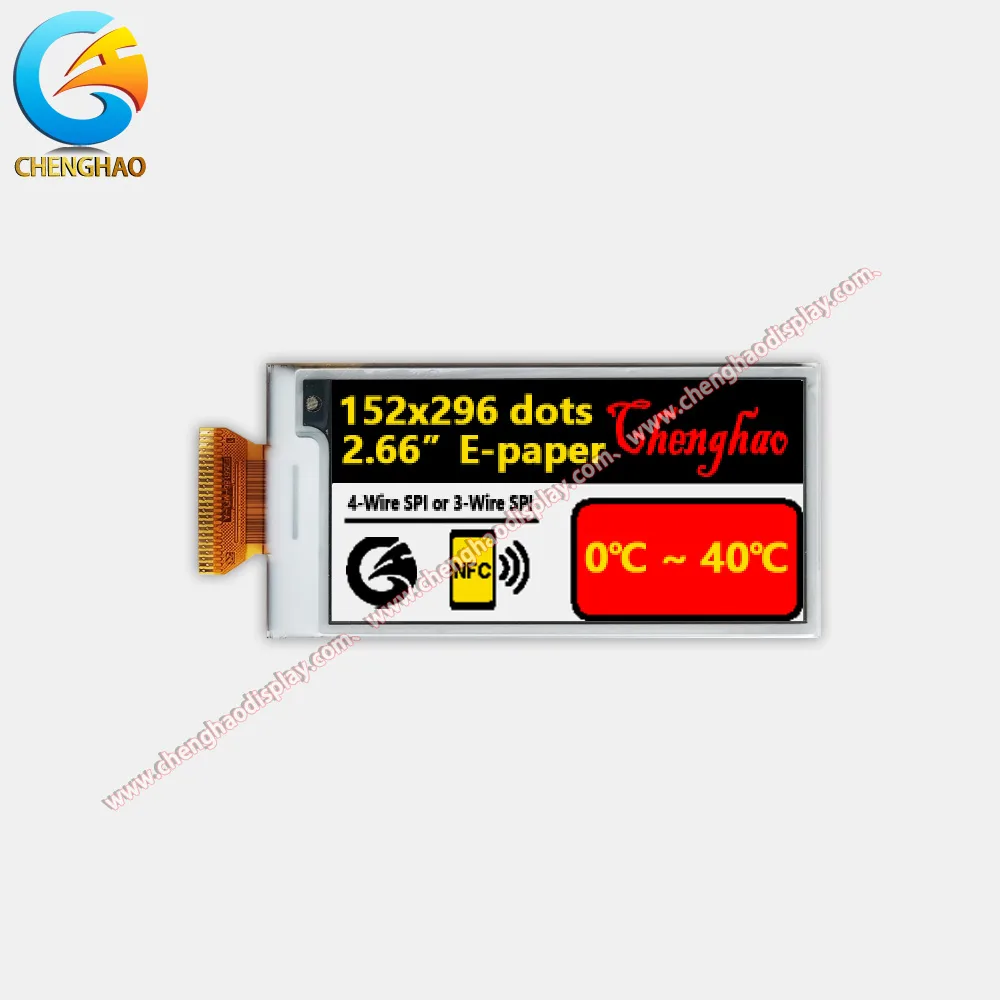
For compact smart labels and embedded information displays, Chenghao offers the CH026620E07 2.66-inch E-paper Display Module.
This module features a resolution of 152 × 296 pixels and a pixel density of 125 PPI, with an active display area of 30.704 × 60.088 mm. Its portrait-format design makes it suitable for compact upright information panels.
One of its main features is four-color display capability, supporting black, white, red, and yellow images. The reflective active-matrix TFT electrophoretic technology provides high reflectance, high contrast, and an ultra-wide viewing angle.
For system integration, the module supports both 3-wire SPI and 4-wire SPI communication. On-chip display RAM and control circuitry are also included to simplify integration into embedded systems.
The CH026620E07 operates within a temperature range of 0°C to +40°C, with a storage temperature range of -25°C to +60°C.
With its compact dimensions, four-color display capability, and reflective low-power technology, this module is suitable for electronic shelf labels, smart tags, portable and wearable information displays, industrial and logistics labels, and battery-powered signage.
For detailed specifications, visit the Moduł wyświetlacza e-papierowego Chenghao o przekątnej 2.66 cala.
Four-color e-paper displays provide an additional way to organize and emphasize information in compact smart labels. By combining black, white, red, and yellow with reflective electrophoretic technology, they support clear information presentation while retaining the low-power characteristics of e-paper.
For projects that require a compact display with multiple color options, Czenghao‘s CH026620E07 offers a 2.66-inch solution with 152 × 296 resolution, an ultra-wide viewing angle, and SPI interface support. It is a practical option for smart labels, industrial identification, and other embedded information display applications.
1. What colors can a four-color e-paper display show?
A four-color e-paper display supports four specific colors rather than a full-color spectrum. Chenghao’s CH026620E07 supports black, white, red, and yellow images.
2. Are four-color e-paper displays suitable for electronic shelf labels?
Yes. Their reflective display characteristics, low-power operation, and ability to distinguish information using multiple colors make them suitable for electronic shelf labels and other static information display applications.
3. What should I consider when selecting a four-color e-paper display module?
Important factors include display size, resolution, available colors, active display area, communication interface, viewing characteristics, and operating temperature. These specifications should be evaluated against the information display and integration requirements of the target device.