


Shenzhen Chenghao TFT and Monochrome LCD Display Development and Manufacturing Processes
22 October, 2025


Search...
Power consumption is an important consideration when selecting a display for battery-powered embedded devices. In applications where information needs to remain visible for extended periods but does not require constant screen updates, traditional display technologies may not always be the most suitable choice. E-paper displays offer a different approach through reflective electrophoretic technology, allowing images to remain visible without continuous power being applied to maintain the displayed content.
For embedded systems such as electronic shelf labels, smart tags, and portable information displays, this characteristic makes e-paper an attractive display solution.
Unlike conventional display technologies that require continuous operation to maintain an image, e-paper uses bistable display technology. Once an image has been updated, it can remain visible without continuous power being required to maintain the displayed content.
This characteristic makes e-paper particularly suitable for devices that display relatively stable information, such as product labels, identification details, equipment status, and other text-based content.
E-paper also uses reflective display technology. Rather than relying on a traditional backlight, it reflects ambient light to make displayed content visible. Combined with its bistable operation, this helps reduce power consumption in applications where screen updates are relatively infrequent.
However, e-paper still consumes power during display updates. Its main advantage is the ability to maintain static images with very low power requirements, rather than eliminating power consumption entirely.
Low Power Consumption for Battery-Powered Devices
Power efficiency is particularly important for embedded products that operate on batteries. E-paper’s bistable characteristics reduce the need for continuous display operation, making it suitable for devices that need to show information over extended periods.
For applications where content changes occasionally rather than continuously, this display technology can help reduce the overall power demands of the display component.
Reflective Display with High Readability
E-paper displays use reflected ambient light and offer high reflectance and contrast. This makes them suitable for applications where users need to read static information from different viewing directions.
An ultra-wide viewing angle also provides greater flexibility when positioning the display within compact devices and information panels.
Flexible Information Presentation
E-paper is not limited to monochrome text. Depending on the module, it can support multiple display colors for presenting different types of information.
For example, a four-color display supporting black, white, red, and yellow can help distinguish important messages, categories, and visual elements without requiring a conventional full-color display.
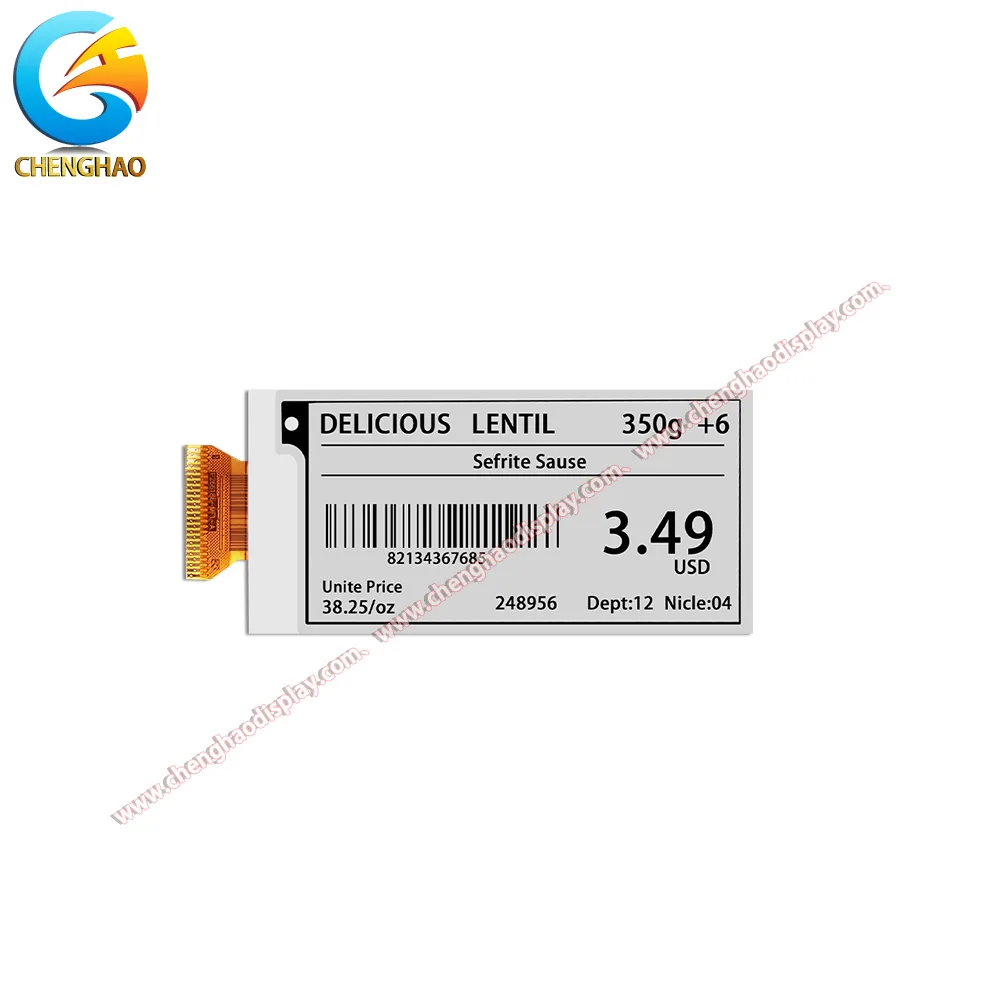
Although low power consumption is an important advantage, selecting an e-paper module requires consideration of several other factors.
Evaluating these factors together helps engineers select a display that meets both the functional and integration requirements of their equipment.
For embedded projects requiring a compact display with low power consumption, Chenghao offers the CH026620E07 2.66-inch E-paper Display Module.
This module uses reflective active-matrix TFT electrophoretic technology and features a resolution of 152 × 296 pixels with a pixel density of 125 PPI. Its active display area measures 30.704 × 60.088 mm, making it suitable for compact information display applications.
One of its key features is four-color display capability, supporting black, white, red, and yellow images. Combined with high reflectance, high contrast, and an ultra-wide viewing angle, it provides a practical option for displaying text and simple graphics.
For system integration, the module supports both 3-wire and 4-wire SPI communication. It also includes on-chip display RAM and control circuitry, helping simplify integration into embedded systems.
Its specified operating temperature range is 0°C to +40°C, while the storage temperature range is -25°C to +60°C.
With its compact design, reflective display technology, and bistable operation, the CH026620E07 is suitable for electronic shelf labels, smart tags, portable and wearable information displays, industrial and logistics labels, and battery-powered signage.
For more details, visit the Chenghao 2.66-Inch E-Paper Display Module.
Choosing a display for a low-power embedded device involves more than comparing screen dimensions and resolution. Power consumption, display technology, viewing characteristics, and interface compatibility all influence the final design.
E-paper is particularly useful when a device needs to present information clearly while keeping power requirements low during static display periods. With its 2.66-inch size, 152 × 296 resolution, four-color capability, and SPI interface, Chenghao’s CH026620E07 provides an option for embedded applications that require compact and energy-efficient information displays.
1. Why are e-paper displays suitable for battery-powered devices?
E-paper uses bistable display technology, allowing displayed images to remain visible without continuous power being required to maintain them. This makes it suitable for battery-powered devices that display relatively static information.
2. Can an e-paper display show multiple colors?
Yes. Color capabilities depend on the specific module. Chenghao’s CH026620E07 supports four colors: black, white, red, and yellow.
3. What interface does the Chenghao CH026620E07 e-paper module support?
The CH026620E07 supports both 3-wire SPI and 4-wire SPI communication. It also integrates display RAM and control circuitry to simplify system integration.


